Thursday, July 19, 2012

Final thoughts for Oslo

Monday, 16 July

Holmenkollen Ski Jump
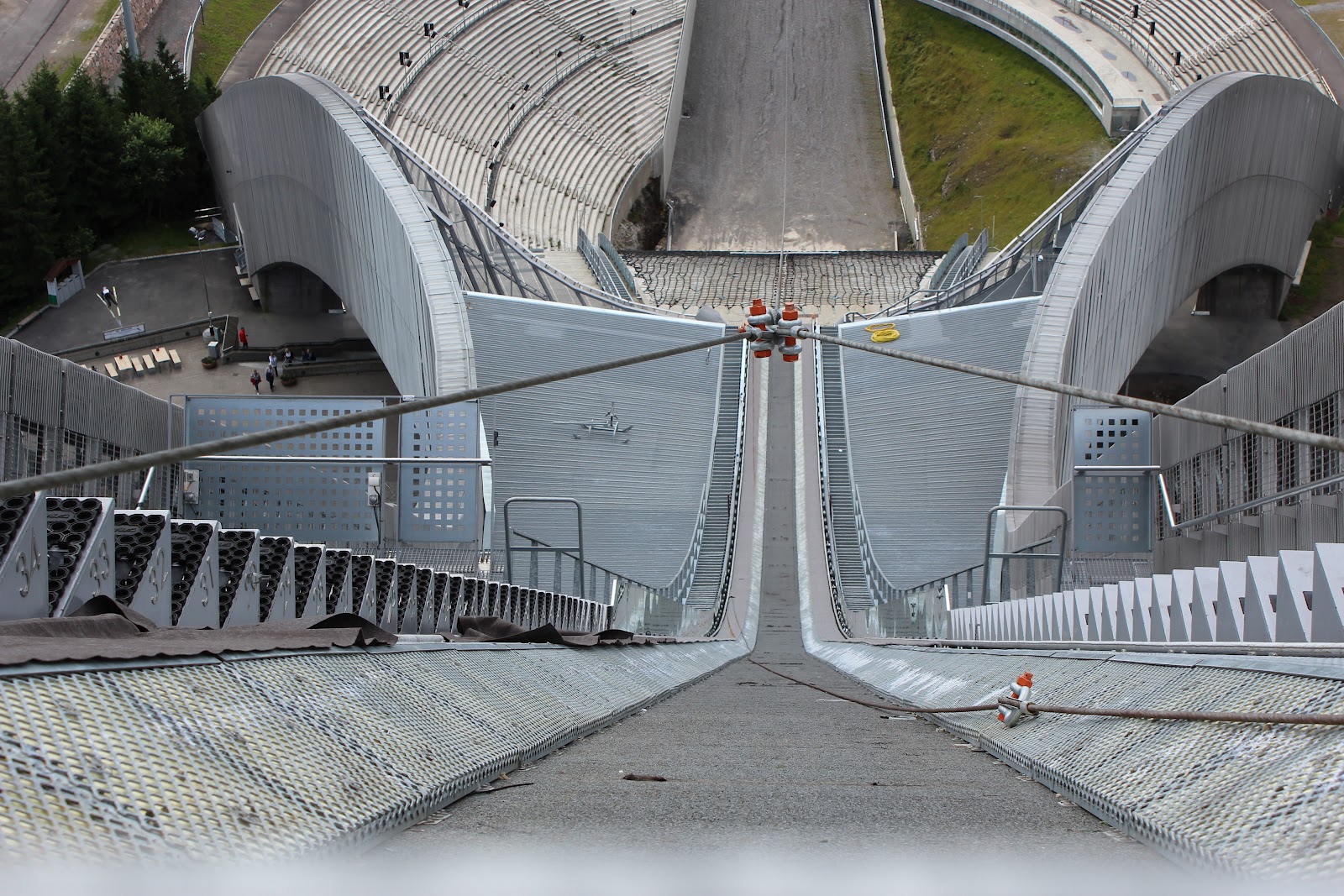
Stop 1 for today was the Holmenkollen Ski jump and Ski museum. It was originally made for the Olympics back in the day, but following a refurbishment last year, it has been reopened to the public.

From the top. It seems less terrifying in this photo, but it is a ridiculously long way down. Ski jumpers be crazy. 
We were pretty rushed at this stop, which is unfortunate because what little I saw of the museum actually looked really interesting. In particular, they have an exhibit at the moment dedicated to disabled winter athletes, showing the equipment they use (and options to have a play with bits of it) and the rules involved in the various paralympic winter sports. The view from the top was staggering, made even better by the fact that it was a perfectly clear day.


This is a recreation of a famous Norwegian photo of a 9 month old child skiing. Yes, nine months old. 

Ye olde ladies skiing costume. Seems practical. 

Oslo from above.

More Oslo from above. 

And some more Oslo from above. 

They had a stuffed brown bear in the gift shop. I don't think I would like to see one in the wild anymore. 
We then went down to Vigeland Park for another stroll through the giant penis garden.
Seriously, this guy needed a girlfriend. And to be kept far, far, far, far, far away from children and animals.
Afterwards, we were dropped at the far point of Bygdøy, where we had the option of visiting the Kon- Tiki museum or the Polar Fram museum. I went to Kon-Tiki, which was quite interesting, but the museum itself was disappointingly set up and didn't really have much information to give context to what I was seeing. What I gathered though is Thor Heyerdahl wanted to prove that it was possible that American tribes had crossed the Pacific Ocean  much earlier than previously thought, and definitely before the age of imperialism. To prove his hypothesis, he made the Kon-Tiki, a raft made using traditional techniques and traditional materials and sailed it across the Pacific.
A recreation of the original raft. It was made from balsa wood.  Seriously, how did (1) anyone think that taking this onto the open ocean was a good idea and (2) it make it???
Following up on the success of this voyage, he then made two more journeys in reed/papyrus boats the Ra and the Tigris. It was really amazing seeing the boats so close up, and looking at them it defies belief that he did actually manage to float them across thousands of kilometres of open ocean.
Me + another boat that probably shouldn't have been allowed to leave the harbours. 
Heyerdahl was also one of the first "popular scientist", writing many popular books about his theories and voyages and using the mass media generally to inform and entertain the public about scientific issues. A documentary made about the Kon-Tiki voyage actually won an Oscar, so I think I'd like to track that down and check it out once I get a bit settled.

Something I forgot to mention yesterday was that the Viking museum, Kon-Tiki and cultural museum are on a bit of land called the King's Court, which is this lovely forested peninsular about 10mins from central Oslo. It was a  gift from one of the kings to the people of Oslo for their recreation, so it has plenty of walking and cycling tracks. It also has a dairy farm which produces significant amounts of Norway's milk. The farm is working towards being completely organic, energy neutral and sustainable by 2013.

The dairy farm on the King's Court.
Finally, we were dropped off the Oslo town centre for some free time. We checked out the inside of the Town Hall on a bit of a whim, and it was lucky that we did. While the outside of the Hall is painfully plain (See the image from yesterday), the inside looks like this.

I would be happy to receive a Nobel Prize in here. 
 

This is one of the many frescoed rooms in the hall. The paintings tell the story of Norway's history...
which apparently included fending off giant insects at some point. 
After that, there wasn't much else for me to do, I just wandered around the city checking out some of the streets off the beaten track, which was actually quite interesting. Oslo is Europe's fastest growing city, and nearly a quarter of its residents are immigrants, so there are little pockets of the different ethnicities encircling the main tourist spots.

I also climbed up their opera house, which was pretty cool. Take note Sydney, all the cool opera houses let people walk an their roofs.

Floating sculpture outside the Opera. It's tethered to the bottom of the river with a single chain, so it spins around when there are winds/waves.
I have had quite a nice time in Oslo, although I 'm not sure I'll be returning any time soon. It feels like a city that is still growing into itself (literally, huge chunks of the city are being re/developed) and doesn't really have enough attractions to hold people for substantial periods.

-Lucy

Ps. The final thing about Oslo that I haven't mentioned is that it is getting some really funky, modern architecture. If hipster was a city, it would be Oslo.


Pps. 
Seagulls are freakishly large here. 

Pps.
I saw these in Oslo, and they didn't really seem to fit in anywhere. But seriously, how good do they look?


Wednesday, July 18, 2012

It's too hard to keep alliterating Sunday

Sunday, 15 July

Today was my second day in Oslo, and it started out smashingly as my hostel provided an amazing hot breakfast. The only problem was that nothing had labels, so I have no idea what most of what I ate was, apart from the bacon. They also had the most delicious peach iced tea, which unless Australian varieties which usually taste like weak cordial, was loaded with flavour.

View over Oslo harbour

My first stop was the Viking Ship museum which houses the remains and artefacts recovered from three Viking burial ships. Like the Egyptians, vikings believed that the rich and fabulous couldn't handle being sent to the underworld without significant troves of worldly possessions, so the boats held sleighs, cooking utensils, weapons, horses, dogs and, in one case, a peacock.


It's amazing how well preserved the boats are today, and even more amazingly how they were built in the first place. Vikings thought measuring things was for weenies, so they cut and carved every piece by sight. The detail in the carvings was amazing - here's a piece which was used to hold rope. See how detailed it is?!? Just for a piece that holds a bit of rope on a dead guy's boat.

The rope-holding thing


They also managed too retrieve partial skeletons from the boats. It's incredible how much information the few fragments are able to tell us. This skeleton is of a male found around Gokstad.


His bones are roughly double the thickness of ordinary human bone, which combined with a flattening of the skull bone at a particular point indicates that he had a tumour meant that he had a hormonal condition (acromegali) which would have made him super strong. They are able to tell that in his childhood, around 5-7yrs old, he was bedridden for an extended period because of some calcifications on particular bones. They believe he was killed in battle because there are several clear cuts on his leg bones, one of which probably severed the femoral artery. As each of the cuts is slightly different, they believe that he died fighting at least 3 opponents.

There are two more partial skeletons, of women aged 50 & 80 which were found on another boat. The elder woman had severe arthritis which meant she most likely walked with a limp and a deep hunch in her back. She had severe cancer, which means that she was in crippling pain prior to her death.
Me + Viking burial ship

Not Viking-ship related, but too good to leave out. 
My next stop of the day was Vigelands Parkland, where Emanuel Vigeland's vast collection of sculptures call home. The sculptures theme is apparently "life, death and the generations", with the centrepiece (made from 120 separate pieces) is "a testament to men relying on each other, and lifting each other up to the sky", according to an audio tour I went on.


Vigeland Sculpture Park

I'm not sure what part of the "circle of life" this is meant to represent. I think Vigeland had a pretty screwed up childhood. 


This is the centrepiece. I'll let you figure out what it is.

Totem pole my ass. 


Finally, I visited the Norwegian Folk Museum. I was a bit apprehensive about this one because I was afraid it would be a tacky tourist trap, but was pleasantly surprised. It's a sprawling outdoor display, with examples of architecture and norwegian life through the various epochs, set amongst some beautiful woodlands. I saw a traditional folk dancing display, which reminded me of the dancing troupe at my old church - lots of old ladies who didn't quite get the beat but had a wonderful time anyway. The most interesting thing was the instrument that accompanied the dance - it's called a Key Harp, and has 16 strings, but only 4 are used played on, the remainder just vibrate to create a deeper sound. It looks like a deep violin, and it's played with a short bow, but also has keys, a bit like a piano accordion.

The Key Harp

The buildings were amazing, particularly considering that they weren't built using any modern implements. The norwegians had a bit of a thing for loft houses, probably because the place is perpetually damp so it was the only way to keep anything dry.
A traditional "loft" farmhouse
The main feature of the cultural museum is the Stave Church which was relocated to its current position in 1884.
Gingerbread Church Challenge - Accepted. 

I was pretty lucky that unlike most places on Sundays, there were still quite a lot of displays going on. I saw traditional pottery, silver smithing and weaving demonstrations. There was also an exhibit on Norwegian pharmaceuticals which was staffed by a few students from the university which was really cool.

The handmade pottery. 

Pottery demonstration. She is turning the wooden wheel with her feet. 

Ye Olde Norwegian Liquor Store. 

The Pharmacy


All through the day, the weather had been lovely, right until I needed to walk the roughly 1km to the bus station, when it promptly started pouring down. After finding out I needed to be on platform P, which maddeningly is located a further 1km away, and nowhere near platforms N, O or Q, I was quite damp.

 I made it to the campsite alive and met up with my tour group who are lovely. The campsite is absolutely picturesque, with a golf course and lake on one side, and a steep hill dotted with cute unit blocks on the other. The only problem is the showers - it costs 10 Nok to showers, and that gives you 6mins of water. Not just hot water. Any water. And it cuts out straight away when your time is up. No 1min warning, just now you're bathing, now you're not. It also costs 40Nok ($8) to do a load of washing which I flatly refuse to pay on the basis that laundry is nowhere near enjoyable enough to spend nearly $10 on.

 Love to all,

Lucy :)

This is the Town Hall. Rather than just having a bell to tell the time, it has a 49 key glockenspiel that plays a different song every hour. Cute the first time. So annoying the 10th. 


Saturday, July 14, 2012

Self-Esteem Saturday

In law, I often feel inadequate. It feels a bit like no matter how hard I try, or how much time or love I devote to a subject, I never excel. Even when I do really well in particular assessment pieces, it never seems to materially change my overall grade so I have, at some point, stopped feeling any sense of accomplishment or pride in what I do across my life generally - all things are just things to be done, and there is nothing remarkable about simply doing the necessary things.

But today I felt an embarrassing rush of pride and achievement for the smallest, stupidest thing - I bought a train ticket.

I had to catch an early metro to get to the airport for my flight, but when I got to the station I found out that the ticket machine would only take coins, not the 50dkk note I was relying on to get me there. There wasn't a ticketing booth around, so I had to walk back to where I remembered seeing a 7/11 the day before and buy the cheapest thing there to get the coinage I needed. It was the smallest, most insignificant thing in the world, but I can't even remember the last time I have felt so pleased with myself.

About 2hrs later I was in Oslo. Norway's such a beautiful country - the airport is about 40mins out of the city, so I grabbed a bus in and the scenery was amazing - lots of really dense, emerald green pine trees interspersed with rolling hills of some kind of ridiculously green crop-grass and quaint farm houses ( you know the ones you see in movies? Burnt red with white beams? Exactly like those ones). I was sitting next to a lovely old lady from Vermont, who was about to go cruising with her son and daughter-in-law up the fjords. I assume that she was some kind of farmer, based on the half-hours worth of chat she supplied about farming techniques which she thinks the Norwegians were/should be using.

Once I managed to abandon my bags at my hostel, I hit the streets, fully intending to get to Akershus Fortress for the changing of the guards. Instead, the Gibson sense of direction kicked in, and I ended up at the Royal Palace. Incidentally, places seem much less royal when there is jack-hammering going on.
 
The Royal Palace, complete with its own construction zone. 

Me (has it been too long to still blame jetlag?) in front of the main street/park/pedestrian mall that joins the Palace to the Parliament.

Thinking I had gotten my bearings, I set off the direction that I thought the harbour, thus the fortress, was in. I ended up at Oslo University. So I turned around again, and somehow got to the Parliament (which is opposite the palace, at the end of a massive pedestrian mall/fountain-filled park).
The Norwegian Parliament building. 

By absolute fluke, I just started looking for tall buildings and walking towards them, and the 1st one I tried turned out to be City Hall, which was close enough to the fortress and shaped distinctively enough on the map that I was able to finally get my bearings and stroll up to Akershus.

Akershus Fortress and Castle is officially dated as having been built around 1300, but it is suspected that it is much older because of a letter the king (I can't remember which one) sent in 1300 which refers to the castle as holding an important document, which suggests that it probably wasn't a mud shack when the letter was written.
Fun fact: to prevent fraud in medieval times, important documents where written in the form of a "Scirogram" (?) , which essentially meant that letters were written out twice, next to each other on a page, and then the page was cut in half in a jig-saw like pattern. One copy was sent to the intended recipient, the other was kept in a safe place, and could be used too verify whether a particular document was the original or a fake.

It says that the fortress was decommissioned in the late 1800s, however the extent of the decommission seems pretty limited to me,  as the grounds still serve as the base for the Norwegian Army and the Prime Minister's offices. The grounds are patrolled 24/7/365 by the royal guards, and overall, it's still a pretty important defence (albeit administrative) location.
This is one of the Royal Guards. Since this is an active military base, I wasn't sure if I was allowed to take photos, thus why this is from so far away. But later I saw him swoop in a save a small child from faceplanting on the stones, so I think I probably could have gotten a bit closer. 
Fun fact: Heat stoke is a problem for the guards. Apparently they did some tests a few years ago and found that the temperature inside their hats can reach 70 degrees, and one soldier got 1st degree burns on his legs once from the heat (although I am deeply skeptical about the latter claim as their boots are leather and it is currently summer and it was 18degees). 

Inside the fortress wall. 

Most of the fortress was developed in response to the introduction of canons  which meant that putting a castle on a hill no longer cut it in terms of security. To store the black powder needed for the canons, several "powder rooms" had to be built. These rooms where usually towers with 3m thick walls and doors which were designed to open upwards, rather than outwards. Men working in the towers weren't allowed to smoke, wear military boots (because they had an iron heel which could spark) or swear (because back in the day they believed that it was possible to curse so badly that you could create sparks).

Powder Tower

 To allow snappy responses to would-be invaders, several Kasematis were built under the grounds. These were bunkers with canons and a small supply of black powder which could be used to start an attack. The most effective use of the Kasematis was on the slope known as "no mans land", where there at 3 canons on each side of the slope, perfectly placed so as to completely cover the field. If men tried to climb up the slope toward the castle, the canons, loaded with shards of metal, would be fired into into the approaching army. 
Fun fact: the soldiers working in the Kasematis lost their sense of hearing because of the noise of the canons in the enclosed space, but they also lost their sense of smell and taste due to the fumes from the black powder.
Kasimatis with 3 canons. These could be shot up to 5 times a minute and were loaded with bits of shrapnel. There's another Kasimatis opposite this, with canons aimed so as to fill the gaps between these 3. 
This Fortress was converted to a prison at some point. 
3m thick walls


The conditions were nothing short of terrible - up to 60men in a cell with only one bucket for the toilet, with the men wearing up to 35kgs of chains. The prisoners were also used for slave labour, which mostly meant teamshit jobs that no one else wanted to do. Now, this is word for word what the tour guide said at this point: "you know, things like emptying and cleaning toilets, taking out trash and stone sculpting". I assumed that when she said "stone sculpting" she really meant working in a quarry. Apparently, not so. Two prisoners were pardoned for their crimes because they did particularly nice sculptures of lions which now adorn the front of the Norwegian parliament building. One of them was a murderer. What kind of punishment is that? "Herman, you have to clean all the toilets, and watch out, everyone had gastro last night. Lars, here's some tweezers, now go and pick up all the rubbish from the streets. Hans, here's 10 tonnes of marble. Make something pretty, won't you?"
Me + the lion statue. 
I mean, it's a nice sculpture, but all this shows me is that the guy really knows his way around sharp tools, so when  he butchers you, he'll do a really nice job of it. 
The entire facility was surrendered to the Nazis during WW2, at which point the Norwegians got shut up in their own prisons, only without the potential for clemency through arts and crafts. It sounds like this is only the second time that foreigners have been able to successfully take Akershus (although not for the lack of Swedes trying). The first was a Swedish duke who attempted to lay siege to the castle and was comprehensively thrashed, so he decided to marry the daughter of the Norwegian king instead and got in that way. Classic if you can't beat 'em, marry their daughter tactics. 

Below is the "maiden tower" which was the original entrance to the castle, until the King put his foot down at having to ride through a dark tunnel (an added defence) in order to get into his castle. This is where the sneaky side of the Norwegians is apparent. They built the castle on a cliff face, so until canons became a thing, the only way in was on land. The land surrounding the castle was swampy, and they only made one, very thin, path through the marsh up to the gate. They also made the approach such that soldiers would be approaching with their right-hand forward, and since most soldiers were right-handed (they wore their shields on their left), this meant that they were approaching with their sword arm exposed which could be easily shot at from the castle walls. Tricky, right?
If you look closely, you'll see three thin slits below the two arched windows - that was where archers hid to knock off approaching enemies. 
I then went on an audio-tour of the inside of the Akershus Castle. The castle was a total work in progress until about the 16th century, with the various residents each adding their personal flair (normally in the form of adding new levels) to the building. 
You can see where each new level has been built up from the last

This was the school room for the royal kidlets. Notice that the wall is painted? At the time, the lower portions of walls were covered with canvas so the children could paint onto them. Here, for some reason, they didn't have canvas, so to mimic the trend, they painted the walls to look like they had cloth coverings. 

Me + a model of the Akershus Castle and Fortress
 The castle is still used for state occasions, so it's pretty impressive that they let tourists traipse through it on a daily basis.
The entrance hall for official events where all dignitaries enter.

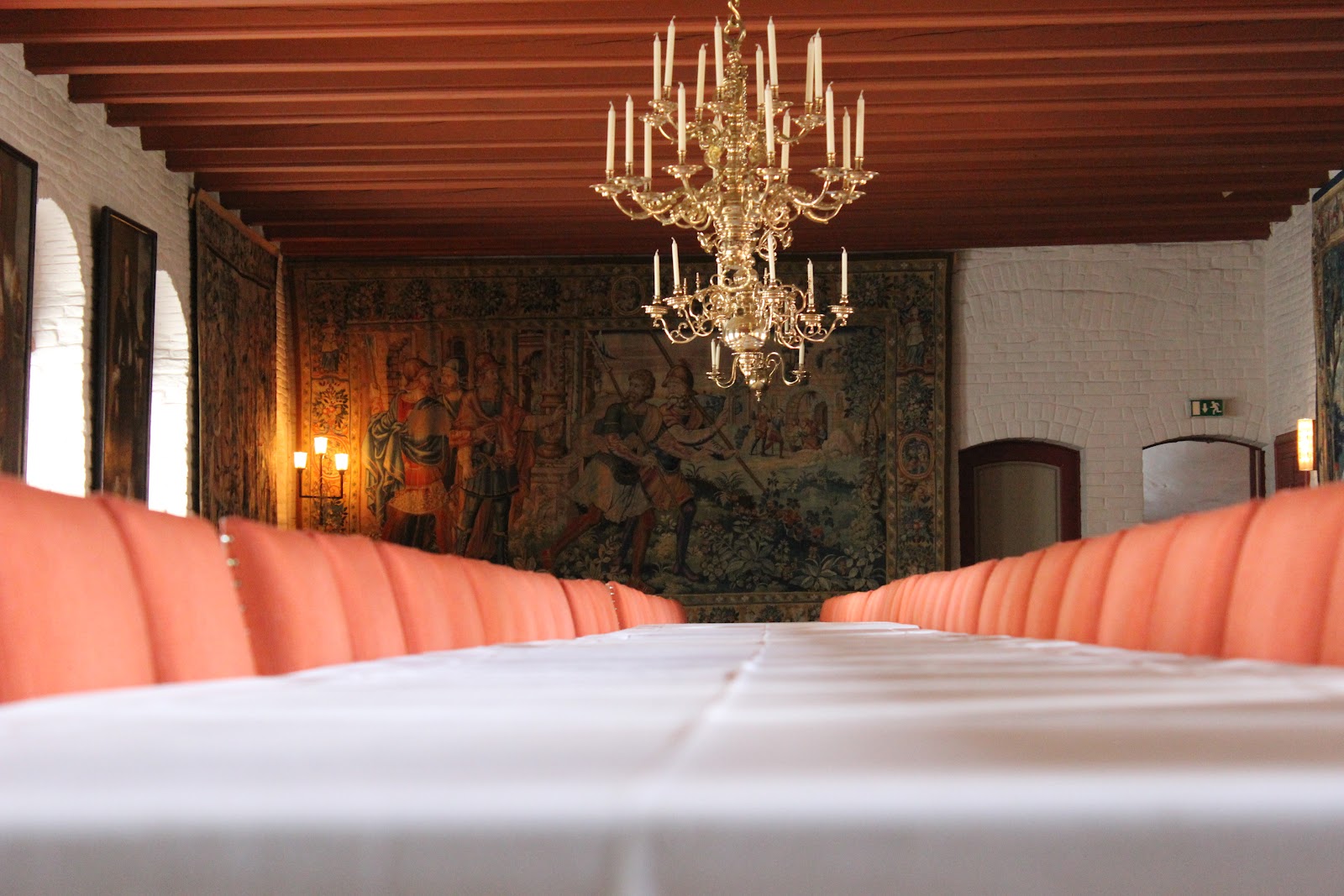
The Official Dining Room 
I have no idea what this is meant to be - it was on the top level in the Men's Chambers.
Tomorrow night I start my Top Deck tour up to the top of Norway, then down through Finland to Estonia, so I'm not sure how reliable my Internet will be for the next few weeks, but I'll be back after that. 

L

Friday, July 13, 2012

Flight Friday

Flight Friday

So in the grand scheme of flights, mine was about as enjoyable as being locked in a pressurised tube and hurtling across a couple of continents can be.

For starters, I scored a window seat, and the seat next to me was empty. The man in the aisle seat was a polite Italian who I suspect suffers from narcolepsy since he easily slept for 12 of the 14hr flight. There was a lot of turbulence though.

My stinginess when it comes to movie-going plays in my favour in planes since I always have about a million  things I want to watch. So this time I hunkered down and watched "The Hunger Games" (which was quite good), "Up" (which was lovely), " We Need To Talk About Kevin" (which was good in it's way, and I see what the director was trying to do, but just didn't really do much for me), "Bambi", "Toy Story 3", "Suits", "Suburgatory", "New Girl". I can't imagine what air travel must have been like before there were TVs in seats.

And the food, look, I think airline food gets a harsh rap which is a hangover from the days before significant portions of the population lived on freezer meals and we only had a fraction of the preservatives. My meals were perfectly nice - coriander chicken with couscous, Harissa beef hot pot with risoni and veggies, date cake with crème anglaise for dinner, veggie curry pies for snacks and a croissant, fruit, and a "breakfast grill" with spinach, beans, sausage, potato, tomato and onion for breakfast (this is mostly for my parent's benefit).

I arrived in Dubai at around 4:30am. That place is crazy - the sun wasn't even up and it was 32 degrees, and 80% humidity. I only had a couple of hours so I chilled out in the airport. Nothing else too exciting happened, apart from walking across the tarmac to get to the plane (by which time it was 38degrees and even more humid)

However, even with my near-perfect flights, after 17hrs I had a fairly severe case of cabin fever and was nearly overwhelmed by an urge to do sprints up and down the aisle. While I maintain that plane food is underrated, the suspicious green cylinders in my mustard chicken nearly pushed me to the brink. Not a moment too soon, I touched down in Copenhagen for the first time.

After I cleared customs and bought my metro ticket, for the first time I actually got excited rather than just terrified about the whole exchange situation. It sounds dumb, but I think it was the sky that did it. Firstly, it's a truly beautiful day - perfect jeans and tshirt weather, but secondly,  in Brisbane, Copenhagen felt like such a long way away and I guess I blew it way out of perspective and expected *Everything* to be completely different. It sounds lame, but it's reassuring that no matter where you go the sky and clouds look the same.

My hostel is lovely, and after settling in I went for a wander around the city. I deliberately didn't look at my map at all until I wanted to come home, so I got delightfully lost. I'm fairly sure that I've visited every park and garden in the city though! It's also the Copenhagen Jazz Festival at the moment, so there were heaps of little stages scattered around with musicians providing a soundtrack to my wanderings.

Copenhaganites also seem to be dog-lovers, to my delight. They're allowed on the metro and into a surprising number of shops, so now all I need to do is find a dog park where I can go when I'm having Barney withdrawals.

Tomorrow (early tomorrow, ugh), I'm off to Oslo.

- L

This is Nyhavn - the cliched photo of Copenhagen

I look thoroughly awful in this photo, but I figure (a) I'm jet lagged and (b) if I'm not in some of the photos you might as well just be Googling "generic Copenhagen photos". 

Possibly the coolest thing I found all day - The Lego Shop! The dragon is made entirely out of lego! 


They also have a station where you can make your own, completely personalised, lego character!

Lots of bikes, some of which must be at least quintuple-parked. 

One of the (many) parks I meandered through today

The Danes seem to place a really high value on green space, and it's absolutely blowing my mind the number of gorgeous old buildings which are carpeted with greenery. It'll be interesting to see how it looks in winter. 

Bomb Threat Thursday aka the time I accidentally told customs I wascarrying heavy weaponry

So the exchange adventure begins.

After a soppy goodbye to my parents and brother, I meandered down to customs. Now, because I am a neurotic type-A personality, I have an incessant need to pass every test, which often makes me quite nervous in perfectly ordinary, non- threatening situations. For
example, I get a nervous rush whenever someone asks to check my bags when I leave shops, when a ticket inspector wants to look at my Go Card or I get pulled over for an RBT.

Customs is like the biggest non-test there is, so naturally I was as jumpy as a drug mule at a Beagle convention. That's probably why they took it pretty seriously when the following transaction occurred:

Customs Lady: Please take any laptops out of their case and put them into the tray
Me: Sure, also, I have an SLR in here, do I need to take it out?
Customs Lady: You have a self loading rifle in your carry on luggage?
Me: *laughs nervously* errr.... No?
Customs Lady: Please step away from the bag.

An explosive trace search, thorough frisking and bag search later, I made it onto the plane.